

“A tax system that ignores women is not neutral, it is blind. […] Women are not asking for tax privileges. They are asking that taxation stop ignoring what they live through.”
— Jean MBALLA MBALLA, Executive Director of CRADEC
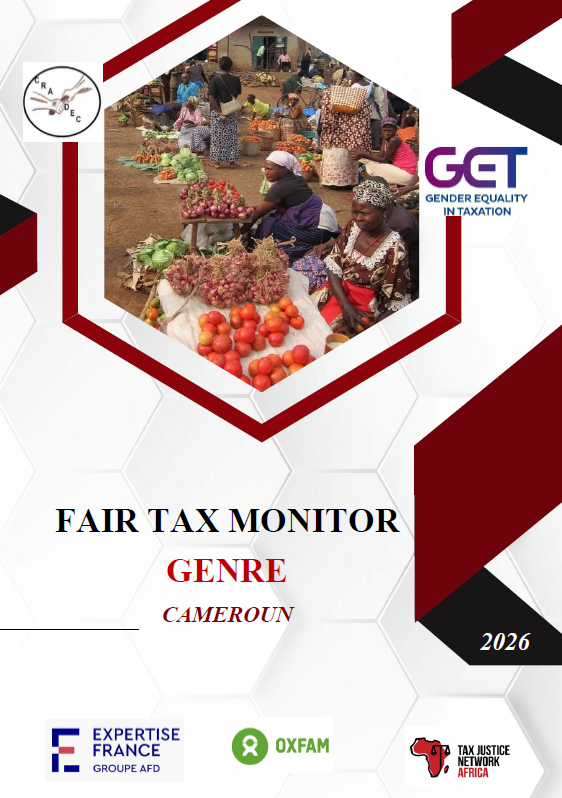
After many months of work, analysis, and consultation, the Fair Tax Monitor (FTM) Gender Cameroon 2026 report has finally been unveiled. Produced by the Centre Régional Africain pour le Développement Endogène et Communautaire (CRADEC), a civil society organization based in Yaoundé that has been working for more than 30 years for social justice and citizen participation, it is the first analysis of Cameroon’s tax system through an explicit gender equality lens.
The report was produced under the Gender Equality in Taxation (GET) project, funded by the French Treasury and implemented by Expertise France, which aims to reduce gender inequalities in tax and customs systems across West and Central Africa. It marks the first time that the FTM methodology – developed by Oxfam Novib, Tax Justice Network Africa (TJNA), and partner organizations – has been applied in Cameroon with an explicit gendered lens.
Key findings: a structurally unequal tax architecture
Weak progressivity with regressive effects. Indirect taxes on goods and services accounted for 57.6% of tax revenue in 2023, compared with an African average of 51.2%, driven by a 19.25% VAT applied almost uniformly, including to many basic necessities. The poorer a household, the larger the share of its income absorbed by these taxes. Tellingly, 40.8% of the benefit from VAT exemptions on food products goes to the richest 20% of households, compared with 5.8% for the poorest 20%. Conversely, personal income taxes, although formally progressive, raise only 5.8% of tax revenue (African average of around 16%) and its exemption threshold has not been revised in more than a decade. As for the informal economy, where 68.3% of employed women are self-employed (compared with 48.2% of men), it remains subject to flat-rate levies with little progressivity.
Insufficient resources and a structural revenue shortfall. With a tax-to-GDP ratio of 12.9% in 2026, Cameroon remains far from the CEMAC (Economic and Monetary Community of Central Africa) target of 17%. Debt service, reaching CFAF 2,065.4 billion in 2025, absorbs nearly 38% of domestic revenue, at the expense of funding essential social services. Illicit financial flows compound this constraint: the National Financial Investigation Agency (ANIF) flagged CFAF 1,665 billion in suspicious flows in 2023, an increase of 180% compared with the previous year. Tax expenditures, for their part, amount to 1.5% of GDP.
Persistent gaps between administrative systems and taxpayers’ realities. Real progress, such as the expansion of e-filing, the digitalization of payments, and the creation of Local and Individual Taxation Centers, coexists with well-documented dysfunctions on the ground: informal levies collected without receipts, no effective appeal mechanism, and inaccessible tax language. In an encouraging sign, the Direction Générale des Impôts (DGI) recently scored 2.53/5 (Level 2, “In progress”) on a gender self-assessment designed by the OECD and ATAF.
Underfunded public spending with limited transformative impact. Allocations to social sectors remain below international commitments: 14% of total expenditure for education (versus the 20% recommended by UNESCO), 4.1% for health (versus the 15% set by the Abuja Declaration), and less than 2% for water and sanitation. Some 72% of health spending is still paid directly by households, a regressive model that directly impacts women. While gender-responsive budgeting (GRB) has been implemented since 2022 in ten pilot ministries, only 1.28% of the general budget was covered in 2025. The ongoing creation of a Gender Center of Excellence within the Ministry of Finance is nonetheless a significant structural step forward.
Insufficient transparency and limited citizen participation. In the absence of any official publication of sex-disaggregated tax data, it is impossible to accurately assess the differentiated effects of tax policies on women. Cameroon scores 20/100 for citizen participation in the 2023 Open Budget Survey: above the global average (15/100), but still insufficient. The established practice of publishing annual tax expenditure reports is a real step forward, even though its methodology is not yet aligned with international standards. The result is a deeply weakened fiscal social contract, in which the most vulnerable taxpayers pay regressive taxes without receiving tangible returns in quality public services.
Five priority recommendations
To set this restructuring in motion, the report puts forward five priority recommendations, designed as a coherent advocacy agenda focused on the reforms with the greatest redistributive impact for women:
- Reform VAT to ease the burden on vulnerable households: adopt a “Gender VAT Package” including a zero rate on essential food products, feminine hygiene products, and water, as well as higher thresholds for the existing VAT exemption on social tariff bands for water and electricity.
- Establish local taxation that is transparent and accountable to women citizens: harmonize and cap market fees nationwide, create a legally enforceable Single Tax Receipt, and require decentralized local authorities to publicly disclose how local revenue is used.
- Mobilize the resources lost to illicit financial flows and unjustified tax expenditures: include a gender impact analysis on the annual tax expenditure reports and strengthen ANIF’s capacity to detect and recover losses.
- Meet funding commitments for essential social services: adopt a binding target of a 17% tax-to-GDP ratio by 2030 and explicitly allocate part of the additional revenue to universal services, with gender tracking of budget allocations.
- Publish and use sex-disaggregated tax data, and institutionalize gender impact analysis: make the regular publication of these data, already collected by the DGI, a formal obligation of the tax administration; subject every tax reform proposal to an ex ante social and gender impact assessment; and formally involve civil society in budget consultations.
Bringing this report to life beyond expert circles
“The problem is not only technical; it is also political and democratic. Cameroon stands at a crossroads. It can perpetuate a system which, under the guise of neutrality, reproduces privileges and inequalities. It can, on the contrary, make the ambitious choice of tax justice as a lever for social transformation and real equality between women and men. This report establishes that this second path is not only desirable, but also technically and financially achievable, provided there is clear political will, strong leadership, and a renewed alliance between the State, civil society, and technical and financial partners.”
— Fair Tax Monitor Gender Cameroon 2026, p.xiv (translated from French)
In his foreword, Jean MBALLA MBALLA expresses the hope that this report will “circulate well beyond expert circles,” and that it will be discussed in parliamentary committees as well as in women traders’ associations, in government departments as well as in newsrooms and local authorities. For, as he reminds us, “a report changes nothing by itself; it is those who take ownership of it who turn findings into decisions.” We wholeheartedly echo his words. We hope that this report will spread beyond specialist circles, reaching deep into Cameroonian civil society, and that it will spark broader reflection on the need to look at society, and the tax system in particular, from the point of view of women and girls.